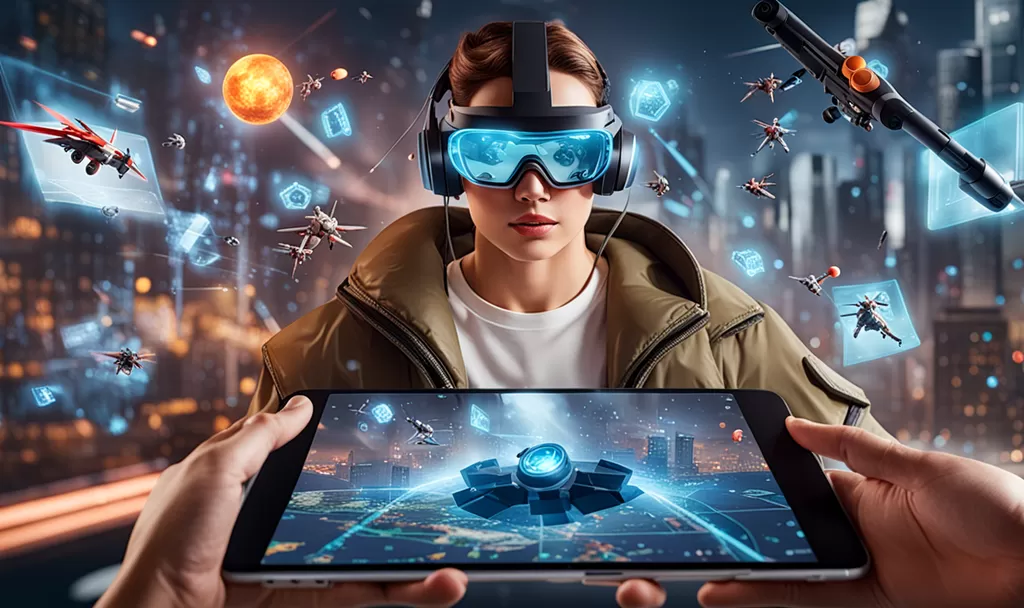
Augmented Reality (AR): The Future of Interactive Digital Experiences
Introduction
Imagine looking through your phone or smart glasses and seeing digital objects appear in the real world — a virtual sofa in your living room, a dinosaur walking in your garden, or directions floating on the road ahead.
This is Augmented Reality (AR) — a fast-growing technology that blends the digital world with the physical world.
From gaming and shopping to education, healthcare, and manufacturing, AR is changing how we see, learn, and interact with information around us.
In this article, we’ll explore what augmented reality is, how it works, its main types, real-life applications, benefits, challenges, and the exciting future of this powerful technology.
What Is Augmented Reality (AR)?
Augmented Reality (AR) is a technology that overlays digital images, sounds, or information onto the real world in real-time.
Unlike Virtual Reality (VR), which creates a completely virtual environment, AR adds virtual elements to your existing surroundings.
For example:
- When you use your phone camera to see how furniture fits in your home (like with IKEA Place).
- When Pokémon GO lets you “see” and catch Pokémon in real locations.
- When your car’s windshield shows navigation directions and traffic alerts.
Simply put, AR enhances the real world instead of replacing it.
How Does Augmented Reality Work?
Augmented Reality works by combining hardware, software, and sensors to detect your environment and overlay digital content accurately.
Here’s a breakdown of how it works:
- Camera and Sensors – Capture your surroundings and detect surfaces or movement.
- Processing Unit – The device (phone, tablet, or AR headset) processes the captured data in real-time.
- Display – Digital images, animations, or information are projected or shown on a screen or lens.
- Software/AR Engine – Platforms like ARKit (Apple) or ARCore (Google) interpret the real-world environment and position digital objects accordingly.
So, when you move your device or walk around, the virtual objects adjust their position — appearing as if they’re part of the real world.
Types of Augmented Reality
There are different types of AR experiences, each with its own technology and use cases.
1. Marker-Based AR
Uses specific markers (like QR codes or images) that trigger digital content when scanned.
Example: Scanning a product label to see a 3D model or video.
2. Markerless AR
Uses GPS, digital compasses, and sensors to place AR objects in the real world without markers.
Example: Pokémon GO or AR navigation apps.
3. Projection-Based AR
Projects light or images directly onto surfaces or objects.
Example: Virtual keyboards projected on a table.
4. Superimposition-Based AR
Replaces or adds digital layers over real objects.
Example: Medical apps that overlay organs or bones on a patient’s body.
5. Location-Based AR
Uses GPS and mapping data to display digital content based on the user’s location.
Example: Google Maps Live View shows arrows and directions on real streets.
Devices That Support Augmented Reality
You can experience AR through several types of devices:
| Device Type | Examples | Description |
|---|---|---|
| Smartphones & Tablets | iPhone (ARKit), Android (ARCore) | Use cameras and screens to display AR. |
| AR Smart Glasses | Microsoft HoloLens, Magic Leap, Nreal Air | Transparent lenses project AR visuals into your view. |
| Head-Mounted Displays (HMDs) | Meta Quest Pro, Apple Vision Pro | Combine AR and VR for mixed reality. |
| AR Contact Lenses (Future) | Mojo Vision prototype | Display AR content directly on your eye (still in development). |
Key Features of Augmented Reality
- Real-Time Interaction: Digital objects respond instantly to user movement.
- 3D Visualization: AR overlays lifelike 3D models in real spaces.
- Spatial Mapping: Detects surfaces, depth, and angles for realistic placement.
- Integration with AI: Artificial Intelligence helps recognize objects and improve interaction.
- Cross-Device Compatibility: Works on smartphones, tablets, and smart glasses.
Applications of Augmented Reality
AR is being used across many industries — improving learning, productivity, marketing, and entertainment.
Let’s explore the most common and powerful uses of AR today.
1. Gaming and Entertainment
AR gaming made headlines with Pokémon GO, where players interact with virtual creatures in real locations.
Now, many games and entertainment apps use AR for immersive storytelling, live performances, and even theme park attractions.
Example:
- Pokémon GO
- Harry Potter: Wizards Unite
- AR concerts and filters on Instagram and Snapchat
2. Retail and E-Commerce
AR is transforming shopping experiences both online and in-store.
Customers can:
- Try on clothes virtually (ZARA, Gucci).
- Preview furniture in their home (IKEA Place).
- Test makeup products in real-time (L’Oréal AR Beauty apps).
This not only improves convenience but also reduces return rates and boosts customer confidence.
3. Education and Training
In schools and universities, AR brings subjects to life.
Students can explore 3D models of the solar system, anatomy, or historical artifacts right in front of them.
In corporate training, AR helps simulate real-world scenarios safely.
Example: Mechanics can learn to repair engines using AR instructions.
4. Healthcare
AR is revolutionizing healthcare by enhancing visualization, diagnosis, and surgery.
Applications include:
- Overlaying digital anatomy for training medical students.
- Assisting surgeons with real-time 3D models during operations.
- Helping patients understand treatment plans visually.
5. Real Estate and Architecture
AR lets buyers and architects visualize properties before they’re built.
With a smartphone or tablet, users can walk through a virtual 3D model of a home or building on-site.
Benefits:
- Saves time and costs.
- Improves design collaboration.
- Helps customers make faster decisions.
6. Manufacturing and Maintenance
AR assists workers in assembly lines or field repairs by showing step-by-step instructions directly in their view.
Companies like Boeing and Siemens use AR to boost productivity and reduce errors in complex manufacturing tasks.
7. Tourism and Navigation
AR travel apps enhance sightseeing experiences.
For example, pointing your phone at a historical landmark displays its history, visitor reviews, or 3D reconstructions.
AR navigation tools also project walking directions directly onto the road or path.
8. Marketing and Advertising
Brands are creating interactive AR campaigns to engage customers.
For instance:
- Pepsi’s AR bus stop ads showed flying saucers and tigers appearing in the real world.
- Nike uses AR to show how shoes look and fit.
AR makes advertising memorable and shareable, increasing customer engagement.
Benefits of Augmented Reality
- Enhanced User Experience – AR makes interactions more immersive and engaging.
- Improved Learning – Visual and interactive elements help users understand better.
- Better Customer Engagement – Businesses attract more attention through interactive AR content.
- Safety and Efficiency – Used in training and industry for safe simulations.
- Increased Sales and Conversions – Shoppers can try before they buy.
- Bridges the Digital and Physical Worlds – Connects real-world objects with digital information seamlessly.
Challenges of Augmented Reality
Despite its promise, AR faces some challenges:
- High Development Costs – Creating advanced AR experiences requires expertise and investment.
- Hardware Limitations – AR glasses are still expensive and not widely available.
- Privacy Concerns – AR apps collect visual and location data that must be secured.
- User Distraction – Overuse of AR can cause distraction or reduced real-world focus.
- Battery and Performance Issues – Continuous camera and sensor use drains device power quickly.
Augmented Reality vs. Virtual Reality vs. Mixed Reality
| Feature | Augmented Reality (AR) | Virtual Reality (VR) | Mixed Reality (MR) |
|---|---|---|---|
| Reality Level | Adds digital objects to real world | Fully virtual environment | Combines AR + VR |
| Device | Smartphone, AR glasses | VR headsets | Advanced headsets (HoloLens, Vision Pro) |
| Interaction | Real-world + digital overlay | Virtual-only | Real + virtual interaction |
| Example | Pokémon GO | Meta Quest VR games | Microsoft HoloLens apps |
The Future of Augmented Reality
The future of AR looks bright as hardware improves and software becomes smarter.
Here’s what we can expect in the coming years:
1. AR Glasses and Wearables
Companies like Apple, Meta, and Google are developing lightweight AR glasses that look just like normal eyewear.
These will project notifications, directions, and even holograms into your field of view.
2. Integration with AI
AR will work hand-in-hand with Artificial Intelligence (AI) to create intelligent assistants that understand context — identifying objects and providing instant help.
3. AR in the Metaverse
AR will be a core part of the Metaverse, blending virtual and physical experiences in work, social, and gaming environments.
4. Industrial and Workplace AR
From construction sites to hospitals, AR will guide workers, visualize data, and improve safety.
5. Education 2.0
AR will make remote learning interactive, allowing students to “see” historical events or scientific experiments as if they were there.
6. Retail Revolution
Shopping will become more interactive — with AR mirrors, 3D product visualization, and virtual assistants helping customers in real time.
Conclusion
Augmented Reality (AR) is no longer just a futuristic concept — it’s already here, transforming how we live, work, and connect.
From gaming and retail to education and healthcare, AR bridges the gap between the digital and real worlds, creating experiences that are more interactive, visual, and meaningful.
As technology evolves, AR will become as common as smartphones — shaping the future of communication, learning, and innovation.
The age of augmented reality has begun, and it’s redefining reality as we know it.



Post Comment